

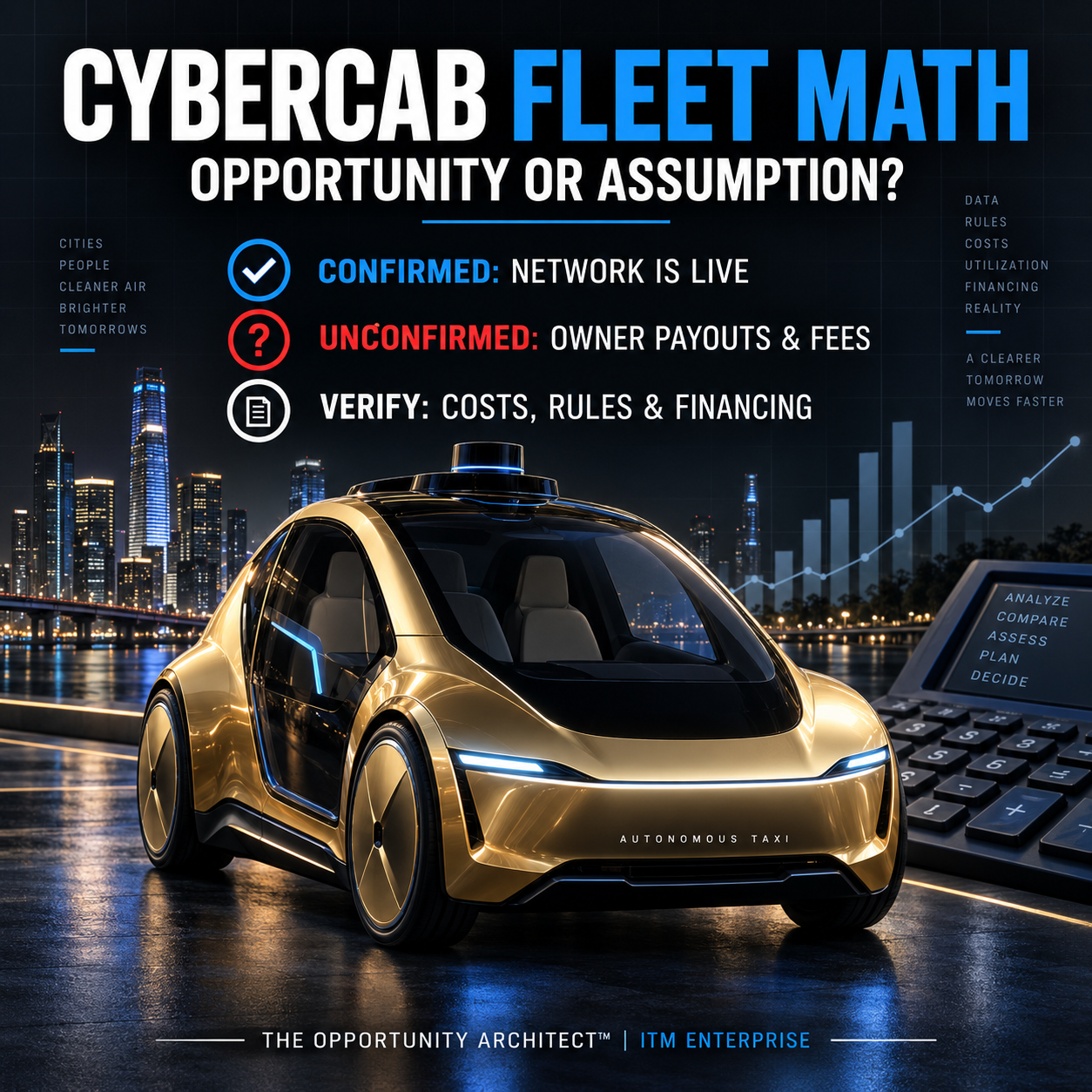
A viral calculation says a five-vehicle Tesla Cybercab fleet could generate nearly $100,000 a year in passive profit. The numbers sound exciting. They also depend on several assumptions that Tesla has not publicly confirmed.
The larger opportunity is still worth watching. Tesla has started limited commercial Cybercab deployment, its Robotaxi service is operating in selected markets, and the company is accepting interest from people and businesses considering future Cybercab fleet purchases. But an emerging opportunity should be evaluated with facts, not just an attractive spreadsheet.
What the viral calculation claims
The calculation begins with a Cybercab purchase price of about $30,000. It assumes each vehicle completes 250 revenue-producing miles every day and generates approximately $4,800 in monthly gross revenue.
It then subtracts a 30% Tesla platform fee, commercial insurance, electricity, and third-party fleet management. The result is an estimated $1,650 in monthly profit per vehicle. Multiplied by five vehicles, that becomes $8,250 per month or $99,000 per year.
The multiplication works. The problem is that the most important inputs have not been established in Tesla’s published commercial terms.
What Tesla has confirmed
Tesla’s Robotaxi support page confirms that its service is operating in limited areas of Florida and Texas. Tesla also says its fleet includes Model Y and Cybercab vehicles.
Tesla’s Robotaxi interest form allows individuals and companies to express interest in Cybercab fleet vehicle purchasing, mobility hubs, and infrastructure. The form describes these as future Robotaxi opportunities.
This is meaningful progress. It does not establish a final purchase price, delivery schedule, owner revenue agreement, platform fee, minimum utilization rate, or expected profit.
What has not been confirmed
- A final Cybercab purchase price available to ordinary commercial buyers
- A guaranteed 250 paid miles per vehicle each day
- The amount an owner will receive per mile or per ride
- A 30% Tesla platform fee
- Owner eligibility and fleet-acceptance standards
- Commercial insurance pricing
- Mandatory depot or fleet-management charges
- Which cities will permit privately owned Cybercabs
- The date privately owned vehicles can begin earning through the network
Tesla currently displays ride prices inside its app and states that pricing can change. A rider’s fare is also not necessarily the same as the amount paid to a vehicle owner.
The original math leaves out major expenses
At 250 miles per day, one vehicle would travel approximately 91,250 miles per year. A serious financial model must consider more than electricity and routine cleaning.
- Financing payments and interest
- Deadhead miles without a paying passenger
- Charging and cleaning downtime
- Tires, repairs, registration, permits, and taxes
- Commercial facilities and charging equipment
- Customer service and fleet administration
- Accident deductibles and liability exposure
- Depreciation and vehicle replacement reserves
- Software, connectivity, or network charges
- Changes in local pricing, competition, and demand
Calling the result “pure net profit” before accounting for these items would be misleading. It is better described as a hypothetical operating scenario.
Financing is another unanswered question
Tesla’s current fleet information lists Model 3, Model Y, and Cybertruck as the vehicles presently available through its standard fleet-ordering system. Tesla says fleet customers may pay cash or arrange third-party financing. Tesla financing is not currently available for fleet purchases.
That means a lender would need to confirm whether a Cybercab is an eligible asset, how it will be valued, what down payment is required, and whether projected Robotaxi revenue can be considered during underwriting.
A first-time operator may also need strong personal credit, documented liquidity, a business plan, relevant experience, insurance approval, and enough reserves to carry the fleet before revenue becomes dependable.
Regulatory risk must be considered
On September 4, 2026, the National Highway Traffic Safety Administration opened an inquiry into Tesla’s Cybercab self-certification following limited commercial deployment in Austin. The inquiry concerns compliance with federal safety standards for vehicles without conventional driver controls.
The investigation does not establish that Cybercab will fail. It does show why deployment dates, eligible markets, and operating rules should not be treated as guaranteed. Read the NHTSA announcement.
How an Opportunity Architect evaluates this
A strong entrepreneur does not ignore a new market because every number is not known. The entrepreneur identifies what is confirmed, what is assumed, and what must happen before capital is committed.
Before buying one Cybercab or planning a five-vehicle fleet, request written answers to these questions:
- What is the final delivered price?
- When will the vehicle be delivered?
- Can privately owned vehicles join the network in the target city?
- How are fares, platform fees, and owner payouts calculated?
- Who pays for insurance, charging, cleaning, maintenance, and storage?
- What happens when the vehicle is unavailable or the market is paused?
- What level of cash injection and operating reserves will a lender require?
The bottom line
Tesla Cybercab could develop into a new class of revenue-producing commercial asset. That possibility deserves serious attention. The widely shared $8,250 monthly fleet-profit calculation should not be presented as a proven result.
The smart move is to prepare early while waiting for verified purchase terms, owner agreements, insurance quotes, operating data, and lender requirements.
ITM Enterprise helps entrepreneurs evaluate capital readiness for eligible commercial vehicles, equipment, acquisitions, and other revenue-producing business assets. Schedule a capital strategy conversation with Travis Toussaint, The Opportunity Architect™.
Important: This article is educational and does not provide investment, legal, tax, or financial advice. Cybercab availability, network eligibility, earnings, and financing are not guaranteed. All financing remains subject to lender eligibility, documentation, underwriting, collateral, and approval.